



Introduction: That One Thing You Change on Purpose
We’ve all been there. You tweak one thing—maybe how long you study, how much water you drink, or how often you exercise—and suddenly the outcome changes. And you think, Wait… was that the reason?
Well, to be honest, that’s exactly where the independent variable comes into play.
Whether you’re a student, a researcher, a teacher, or just someone trying to make sense of experiments and data, the independent variable is the quiet hero behind every “cause-and-effect” moment. It’s the factor you control, the one you deliberately change to see what happens next.
And once you truly understand it, trust me, experiments and research stop feeling confusing—and start making a lo
What Is an Independent Variable? (In Plain English)
The Simple Definition
An independent variable is the factor in an experiment that you intentionally change to observe its effect on something else.
That “something else” is usually the dependent variable—but we’ll get to that soon.
So, if you remember just one thing, remember this:
The independent variable is the cause.
Why It’s Called “Independent”
You know what’s interesting? The independent variable doesn’t depend on anything else in the experiment. You choose it. You control it. It stands alone.
For example:
- You decide how many hours someone studies
- You choose the temperature of water
- You set the amount of fertilizer for plants
Those choices? Yep, they’re all independent variable
Independent Variable vs Dependent Variable (Let’s Clear the Confusion)
A Quick Side-by-Side Comparison
This mix-up happens all the time, so let’s slow it down.
| Independent Variable | Dependent Variable |
|---|---|
| What you change | What you measure |
| The cause | The effect |
| Controlled by you | Responds to change |
So basically, the dependent variable depends on the independent variable.
A Real-Life Example
Let’s say you’re testing this question:
Does drinking more water improve concentration?
- Independent variable: Amount of water consumed
- Dependent variable: Level of concentration
And suddenly, it clicks.
Why the Independent Variable Is So Important
It Drives the Entire Experiment
Without an independent variable, there’s no experiment—just observation.
Actually, every scientific study, school project, or market test starts with identifying the independent variable. It’s the backbone of research design.
It Helps Prove Cause and Effect
Here’s the big deal: correlation doesn’t equal causation.
But when you manipulate an independent variable and observe changes, you move closer to understanding why something happens—not just that it happens.
And that’s powerful.
Types of Independent Variables You Should Know
1. Continuous Independent Variables
These can take any value within a range.
Examples:
- Time (hours, minutes)
- Temperature
- Distance
So, studying for 1 hour, 2.5 hours, or 6 hours? Still the same independent variable—just different values.
2. Categorical Independent Variables
These are grouped into categories.
Examples:
- Gender
- Teaching method (online vs classroom)
- Type of diet (vegetarian vs non-vegetarian)
No in-between here—you choose a category and measure the effect
Independent Variable in Science Experiments
Classic Science Fair Example
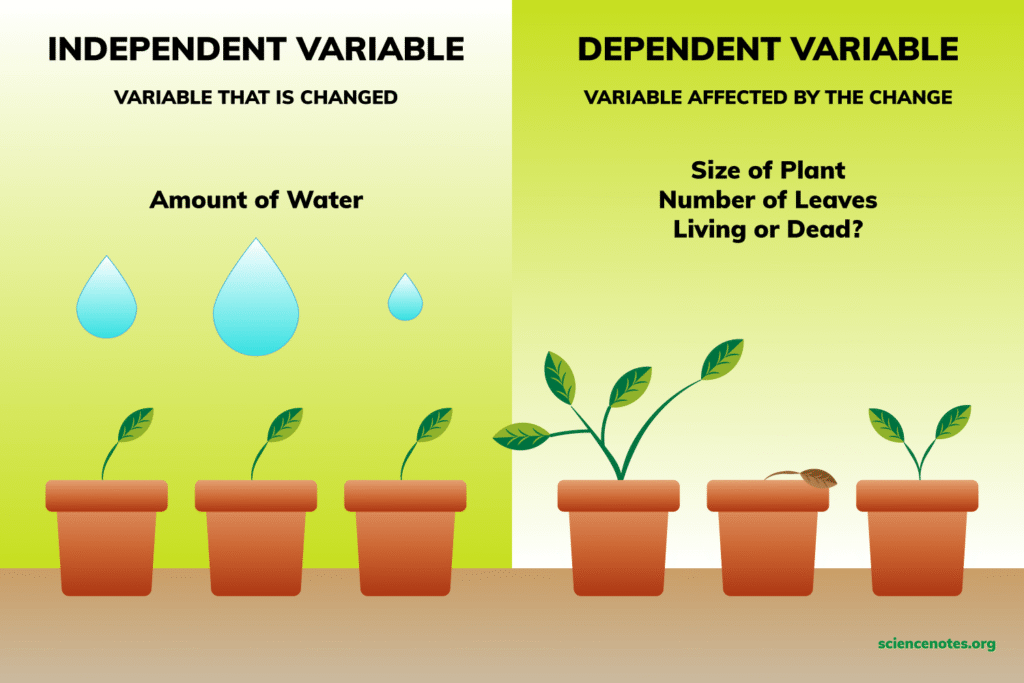
Remember the plant experiment from school?
“Does sunlight affect plant growth?”
- Independent variable: Amount of sunlight
- Dependent variable: Plant height
You change the sunlight exposure and observe what happens to the plants.
Simple. Effective. Timeless.
Why Scientists Control Other Variables
You’ll often hear about “controlled variables.” These stay the same so they don’t interfere.
So, while sunlight changes:
- Water stays the same
- Soil stays the same
- Pot size stays the same
That way, any change in plant growth can be linked to the independent variable with confidence.
Independent Variable in Social Science and Psychology
Human Behavior Makes It More Interesting
In psychology or sociology, independent variables often involve behaviors, environments, or experiences.
Example:
Does listening to music while studying affect memory?
- Independent variable: Presence of music
- Dependent variable: Memory test score
And yes, this is where things get fascinating—because humans don’t always respond predictably.
Independent Variable in Business and Marketing
Where Data Meets Decisions
Businesses use independent variables all the time, even if they don’t call them that.
Examples:
- Changing product price
- Altering ad design
- Adjusting email subject lines
The outcome?
- Sales
- Click-through rates
- Customer engagement
So, the independent variable becomes a tool for growth, not just theory.
Common Mistakes People Make with Independent Variables
Mistake #1: Confusing Cause and Effect
It happens more than you’d think.
If you’re measuring something, it’s probably the dependent variable—not the independent one
Mistake #2: Changing Too Many Variables at Once
We’ve all tried this, right?
You change diet, sleep, exercise, and screen time all at once—and then wonder what worked.
But in experiments, changing multiple independent variables makes results unclear. One change at a time is the golden rule.
Mistake #3: Poor Definition
An unclear independent variable leads to unclear results.
Instead of:
- “More study time”
Say:
- “Two additional hours of study per day”
Precision matters.
How to Identify the Independent Variable (A Simple Trick)
Ask yourself:
What am I intentionally changing?
If the answer is yes, I control this, then congratulations independent variable found your independent variable.
Another helpful tip:
- Look for the “if” in the question
“If I change this, what happens?”
That “this” is almost always the independent variable.
Why Understanding the Independent Variable Actually Helps You in Real Life
Better Decisions, Less Guesswork
When you understand independent variables, you stop guessing and start testing
Want better productivity
- Change work hours
- Measure output
Want better health?
- Adjust sleep time
- Track energy levels
Life becomes one big experiment—in a good way.
It Builds Critical Thinking
You stop accepting results at face value and start asking:
- What was changed?
- What was measured?
- Was anything else affecting the outcome?
And honestly, that skill is priceless.
Independent Variable in School and Exams
Why Teachers Love This Topic
It’s fundamental. From middle school to university, the independent variable shows up everywhere.
Understanding it helps with:
- Lab reports
- Research papers
- Exam questions
And once you “get it,” you’ll never mix it up again.
Conclusion: Master the Independent Variable, Master the Experiment
So here’s the takeaway.
The independent variable is the intentional change—the starting point, the spark, the “what if” behind every experiment. Whether you’re growing plants, studying behavior, running a business, or improving your own habits, it’s the factor that sets everything in motion.
And once you understand that, learning becomes clearer, experiments become smarter, and decisions become more confident
